Showing posts with label scuba diving. Show all posts

Friday, March 21, 2008

Curacao

It was another hectic morning. I discovered the hard way that the early bird breakfast at the Windjammer is a continental breakfast. I hate those. Continental breakfast is two words meaning starve. Unfortunately, I didn’t have time to wait for them to put out the regular breakfast items. I rushed back to my cabin, grabbed my diving gear and did the same routine again. Luckily, this would be the last time I’d go diving on this cruise so I wouldn’t have to mess with security again over my dive knives.

A guy named Jeremiah was waiting for the dive group at the pier. I forget what his nationality was but, he told me was married to a Dutch girl and had worked at a dive spot in Egypt before coming to Curacao. He’d travelled a good bit of the world. He seemed pretty cool. Once everyone had arrived, Jeremiah directed us to some taxis which would take us to Ocean Encounters. The drive was interesting as we got to see a bit of Willemstad.

Once we arrived at Ocean Encounter’s dive shop, we started setting up your gear or were issued gear if we rented it. Then, we received a briefing on how things were going to work. We were going to do a beach entry. Once we were in shallow water, we’d slip our fins on then, we’d work our way out to the dive point. Once there, we’d let the air out of our BCDs and descend down to the reef. If someone hit the halfway point on their air, they’d let the leader know and they’d head back with the leader’s assistant. The rest would carry on until it was time to turn back.

We made our way out to the beach. I waded into the water and promptly had problems getting my fins on. Then, I put air in my BCD and swam with the rest of the group to the dive site. While swimming out there, I swallowed damn salt water again. That stuff is nasty. I ended coughing some of it up when we got to the dive site. Thankfully, once I started breathing through my respirator, I was fine.

The reef itself was impressive with a large variety of coral and fish life. Visibility was outstanding at 65 feet plus. The reef wall supposedly descended down to 350 feet though the deepest I went was 62 feet on the first dive and 63 on the second. I didn’t have any problems equalizing on the first dive but I did on the 2nd to my great annoyance. I tried to overcompensate and ended up giving myself a bloody nose. I was frustrated with my left ear and pretty certain I had an ear infection.

In regards to Ocean Encounter and their people, I was very pleased with them. I thought they really tried to ensure we had some nice dives. The only thing I would do differently is make sure I go out on a boat vice doing a beach entry. Boat entries are loads easier.

After we returned or packed up our gear, we got back into the taxis that brought us to Ocean Encounter’s and returned to our ship. I grabbed some lunch and decided to stay on board. It looked like it might be a long walk to some shops in town. It turned out I was wrong. There is an easy walk to a number of shops and the remains of one of the old forts.

Departure time was 4:30 p.m. Apparently, some people thought that meant they could return at 4:35, 4:40 and two ladies even showed up at 4:45. They got royally razzed by those of us who were stuck waiting for them. They also got lucky Captain Nyseter didn’t depart. If he had, they would’ve had to fly to St. Maarten at their own expense to rejoin the ship.

I chatted with my friend Harvey and found out what he’d been up. I watched as we sailed east along the coast of Curacao. I decided to see one of the shows the ship out on in the Lyric Theater. It was called “Can’t Stop the Rock.” It featured music from films from the past 40 years. It turned out to be a nice production. I wouldn’t have paid money to see it but it was fun to watch and something to do. Afterwards, I had a nice dinner at the Windjammer. Later, our ship Adventure of the Seas changed tack and sailed northeast to St. Maarten. We would be at sea for an entire day. Stay tuned.

Thursday, March 20, 2008

Aruba

Land ho! Land on the starboard bow! I didn’t actually say that from my balcony as our ship arrived at Oranjestad, Aruba BUT I was tempted. I’d been at sea for 33 hours at that point which is the longest I’d ever been to sea. Aruba seemed flat and heavily built up. The cruise ship pier was easy to pull up to and it took little time for Captain Nyseter to pull along the pier. For me, I had to pull my dive bag to one of the glass lined elevators and go up to deck 11 where I checked in for the dive trip. Then, I had to take the elevator down to deck 1 to get my dive knives from Security. I had to show them my receipt for the knives. They found my knives and I returned to deck 11. When it was time, our group descended to deck 1, had our SeaPasses scanned and walked one of the gangways to the pier. A lady was waiting for us. She took us to the boat that we’d use for our dives. Sadly, I can’t remember it’s name. Ton, a retired Dutch IBM executive, was the first mate. He shepherded us to spots on the boat and told to use to start setting up our gear if we brought it or issued it to those who didn’t.

When all were aboard, we left for the boat’s dive shop as they were short 2 pairs of fins for members of our group. Once we left their shop, we proceeded to the location of the Antilla wreck. The Antilla was a German freighter which was off the coast of Aruba at the start of World War II. Apparently, German authorities didn’t warn the ship of the pending invasion of the Netherlands. When Germany invaded the Netherlands, the ship was at anchor. So, when war broke out, Dutch authorities in Aruba came on board the freighter and informed her captain that they were going to seize the ship. The captain pleaded for 24 hours. The authorities foolishly gave it to him. Once the authorities left and were out of sight, the captain proceeded to scuttle i.e. sink the ship. When the Dutch authorities returned the next day, they found out what he’d done. The captain and his crew spent the whole of the war as prisoners of war. Later, he moved to Bonaire where he opened a hotel. There, you can see a picture of his freighter. I heard this story from Ton who was explaining to us about the wreck.

On our way out, we got paired up. I got paired with a guy named Tony. We were part of a 6 diver group that went with Ton’s assistant. When we arrived at the dive site, we took frog steps into the water. Then, we followed a line to the anchor line where we began descending to the bottom.

The wreck was in good shape for a World War II ship. It was also BIG. It was 400 feet long. We dove along side it seeing the various corals growing on the wreck as well as various species of fish. Visibility was at least 35 feet. Ton’s assistant pointed out things of interest including a very long light green Moray eel. The dive lasted at least 35 minutes. When it was time, our group began ascending the anchor line back to the ship. After our group was aboard, we waited for Ton’s group to return. While waiting we changed to fresh tanks of air. Once the second group was aboard, the board departed for the 2nd dive site.

The 2nd dive site was the wreck called the Pedernalis. According to Ton, two German subs were prowling the waters one night off Aruba. The first fired a torpedo which hit a ship but it failed to explode as the crew forgot to the take off the cap which covered the detonator. This tipped off ships that subs were in the area. Luck was not with the Pedernalis which headed straight in the direction of the second German sub. The crew on the second sub made sure the torpedo detonator was uncovered. The ship sank in 25 feet of water. As it sank in such shallow waters, people on shore who owned hotels on shore didn’t like their guests seeing a sunken ship so they asked the Dutch authorities to do something about it. They gladly took care of the problem by blowing the wreck to bits. You can see various pieces on the ocean floor.

After the 2nd dive, we headed back to the cruise ship pier. Ton and his assistant did a great job. The company they’re with is called Red Sail Sports. Later, I visited their dive shop which in my opinion wasn’t very impressive. Still, I’d gladly go diving with them again.

I returned to the ship and turned my dive knives back in to security. I dumped my bag off at my cabin. I grabbed something quick to eat for lunch at the Windjammer. Then, I left the ship again so I could see a little of Oranjestad and take some pictures. From what I saw of the town, I wasn’t impressed. I was amazed by how many jewelry stores they had. I believe they were there for the steady flow tourists that arrived by cruise ship. At St. Maarten, the fishing boat assistant there told me they had 1 cruise ship come in to port every day. Considering how many people are on those ships, I suspect the stores get a good bit of business.

After wandering around for 45 minutes or so, I returned to the ship. I caught up with Harvey and found out how his tour of Aruba went. According to him, they must have driven the length of the island twice during their tour. From listening to him, it didn’t sound like there was a lot to see in Aruba.

Around dinner time, I returned to the Windjammer and it’s sister cafĂ©. Departure time at Aruba was 8 p.m. This meant it was dark when we left. The Windjammer is at the end of deck 11. It has large glass windows so passengers can look out and see the surrounding area. This was a huge plus as I got to see Oranjestad all lit up at night as we departed. It was really impressive. Our next port of call was Willemstad, Curacao. I looked forward to my next adventure. Stay tuned.

Wednesday, March 05, 2008

Dive Shop

I visited Columbia Scuba (http://www.columbiascuba.com/) today. One of the pieces of equipment I decided I wanted to take with me is a small underwater flashlight. The flashlight would be useful for looking into crevices and nooks. When I tried turning the flashlight on, it wouldn't come on. I assumed the batteries were dead so the next day, I drove to Safeway and bought some new batteries. I installed them and the flashlight still wouldn't come on. I decided to take the flashlight to Columbia Scuba and see if they could figure out what was wrong with it. If they couldn't, I'd buy a new one. It turned out that a) I put the batteries in wrong and b) the bulb was burned out. The flashlight didn't have any kind of diagram showing how batteries should be put in. As far as the bulb, the only thing for that was replacing it. To my surprise, it cost over $20.
Another diver was at the time shop while I was there. Unlike me, he had gone on a number of dive trips. I asked him what he could think of that I might need. He came up with 3 things. The first two were standard: mask defogger and ear drops. Mask defogger keeps your mask from fogging up once you get in the water. Ear drops keep you from getting an ear infection while diving. I learned the hard way how important these were. The last item he came up with was a whistle. Why would a whistle be important? It would be very important if you surfaced away from the dive boat you're using. Blowing a whistle would help you get the attention of the people on board. The whistle the dive shop sold me reportedly can be heard up to 1 mile. Another item the fellow recommended was spare fin and mask straps. These can break and there isn't any guarantee the company you're diving with will have replacements. Unfortunately, there are specific straps for specific masks so I'll have to go back to Columbia Scuba tomorrow so they can match up my mask with the right strap. Concerning the fin straps, I thought I had spares of those but, it turned out I was wrong so, I'll be buying some of those tomorrow too. Lastly, I plan to buy some electrical ties so I can secure my diving bag. If the TSA folks want to check something in my bag, they can easily cut the tie. The securing the zippers on my bag, I'll make sure some baggage handler doesn't get tempted to help themselves to a free diving knife or fins.

Tuesday, March 04, 2008

Trip Preparation

I've begun getting my scuba diving equipment together for my trip to the Caribbean. As previously mentioned, this will be the first time I'll have travelled with the stuff. It's a bit of a challenge because you have figure out what exactly to take. Some scuba diving equipment is very heavy ex. weights and because of weight limits you don't want to take those. You're not allowed to bring some equipment on board planes. I found out I can't check in my spare air tank because you're not allowed to check pressurized air tanks. My travel agent told me one person did that one time and the tank exploded causing the plane to crash. In regards to the stuff you can take with you, once you take, you're going to be lugging it with you the whole trip. So, do you really need that anchor line finder? Are you going to need a wreck reel? Will you need an underwater flashlight? Scuba diving equipment tends to be expensive so you don't want to leave something behind and then have to buy it again at a local dive shop. Some equipment uses batteries. You have to make sure the batteries are still good though you might want to replace them to be on the safe side. You don't want the batteries to die while you're diving or have to go in search of batteries in some foreign country. Lastly, you need to remember to bring your certification cards and dive log. The cards are necessary to prove you're qualified to dive. The dive log is important so you can prove later that you did the dives you said you did. When I show up to do 2 dives in Aruba, they require proof that I've dived in the last two years. My dive log will be my proof as it'll show where I did my 2 check dives and have the signature of the divemaster that accompanied me on the dives. For me, all this is new and challenging. Yet, it is exciting too. I can't wait to see underwater world in the Caribbean.

Tuesday, November 20, 2007

Diving in Puerto Rico

I called Karen Vega at Caribe Aquatic Adventures in San Juan, Puerto Rico today. I wanted to pay in advance for the two refresher dives I need to do before I go on my Southern Caribbean cruise. By paying in advance, I'll have fewer charge card bills when I get back from the cruise. I haven't forgotten my Globus Australia tour where I was paying for it 3 months after the tour. If you can pay for various things in advance on a cruise or tour, I'd recommend you do the same. It really does things nicer when you get back from your trip.
The diving part of the cruise will be interesting it that it'll be the first time I'll take my diving equipment on a trip. Also, I've never dived in the Caribbean. I remember diving out of Destin, Florida. We'd get people who had dived in the Caribbean. They would whine about our 20 foot visibility. It seems in the Caribbean, it isn't uncommon to have 60 foot plus visibility. I can only guess that the waters there don't get stirred up like they do in the Gulf of Mexico.
I've heard the sea life is supposedly spectacular. I plan to take the cheap underwater camera I bought in Australia so I can try to take some underwater photos. We'll see how that works out. If they turn out nice, I'll post a few here.

Monday, October 08, 2007

San Juan

I called Joel Mills from Carlson Wagonlit today. I wanted to get my airline reservations, hotel reservations and San Juan tour finalized. I was able to get the flights I wanted to and from San Juan. I'll fly out on March 7th arriving in the afternoon. I'll stay at the Normandie Hotel which has an excellent location in regards to the cruise ships, Old San Juan and the San Juan tour picks up from there. I'll have the rest of the day to explore San Juan on my own. On March 8th, I'll do the Bacardi Distillery and Old San Juan tour in the morning. I'll have the afternoon free to do whatever. On March 9th, I'll do my two check dives in the morning. I'll get back around noon and, I'll probably check into the cruise ship shortly afterwards. There won't be any point in delaying that.

On March 16th, the Adventure of the Seas will pull back into San Juan at 7 a.m. I'll take a taxi from there to the airport and waste about 4 hours. I fly out around 12:45 and arrive at Washington Dulles Airport 4 hours later. The flights from and to Dulles will be the first time I've ever flown out of that airport. That should be interesting.

Cruise wise, I plan to do 2 diving excursions, hopefully go deep sea fishing and ride a helicopter for the first time. I'm curious to see what the ship is like. I've seen the photos on the internet but photos don't really convey the full impact of what it'll be like. I won't know that till I'm actually on the boat exploring the various decks. It should be something to see. San Juan and the cruise are shaping up to being another neat adventure.

By the way, if any of my readers would like some used travel guides to Scandanavia, Australia, New Zealand, London, and Scotland, please let me know. If I ever make it back to some of those places, I'll undoubtedly buy new ones so you're welcome to have them. The Australia and New Zealand guides are over 3 and 1/2 years old. I don't know how long I've had the London and Scotland guides.

Sunday, October 07, 2007

Scuba Diving

One of the things I really enjoyed when I was stationed in Northwest Florida was scuba diving. Every time you go diving, it's an adventure because you don't know what you're going to see or what the conditions will be like. Some days, you can have great visibility i.e. you can see for great distances while other days, you're lucky if you can see 10 feet in front of you. Sadly, because of the cold water and distances to Ocean City, I haven't scuba dived in Maryland. I've taken a couple courses and I dived in a quarry in Virginia but, I haven't scuba dived in the Atlantic.
One really neat aspect of the cruise I'll be going is that I'll be able to go scuba diving. I've heard the visibility is incredible in the Caribbean. It should be a lot of fun but, I have run into one problem. All the dive shops down there require you have done 2 dives within the last year or two. I haven't dived since I went on my trip to Australia. I did 2 dives on the Great Barrier Reef then. So, I've been trying to figure out how I could do a couple check dives to make sure I still know what I'm doing diving wise. I figured out that the best option was to do the check dives in San Juan just before the cruise. It's the easiest option though I then had the problem of finding a dive shop in San Juan. I finally found one. So, things are looking up that way. The cruise promises to be another first because of the diving. For the first time, I'll be traveling with my diving gear. In preparation for that, I looked up the rules on what I could take on the airplane. Can I bring a diving knife? What are the weight restrictions? What other things am I allowed to bring? Are there any additional fees? It'll be interesting in that way. The lessons I learn from this may help me on future trips.

Sunday, October 16, 2005

Cairns - Part II

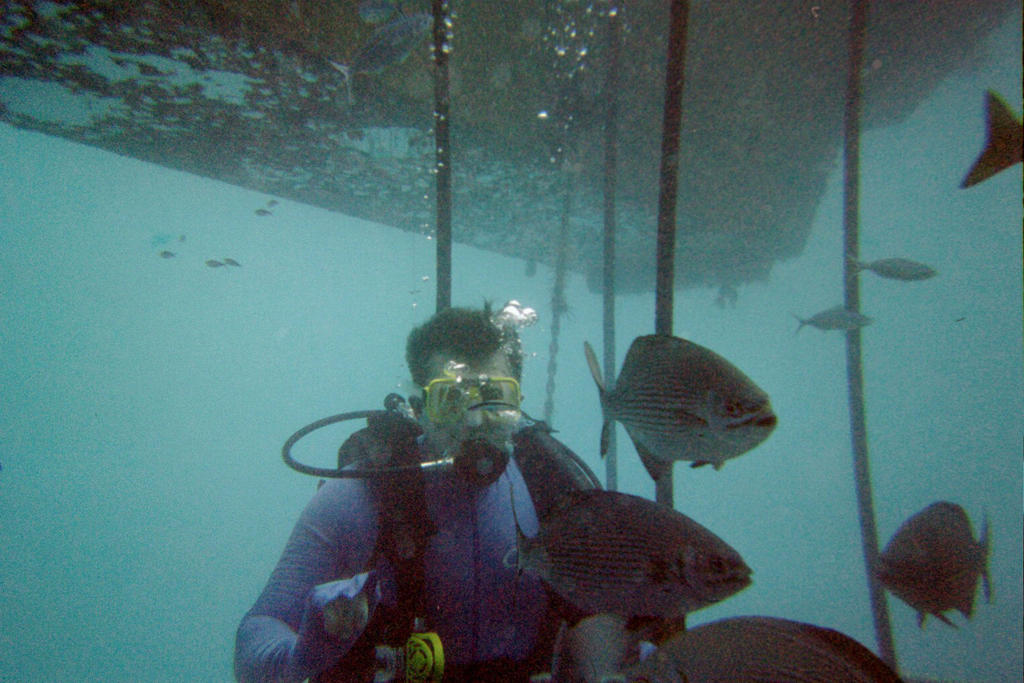
A couple days ago, the lady known as A2^ sent me a comment. She said that she was going to put climbing the Sydney harbor bridge on her list of things to do before she died. I replied that another thing she would want to put on that list was scuba dive the Great Barrier Reef. Why? First, it one of the largest living organisms in the world. It is so big that astronauts in space can see it. Second, it has one of the largest collection of creatures on this earth. The number has to run into the thousands. Third, it is a place where man can enter a totally alien world without having to go into space or beyond. The underwater world is totally different from our own. Even with all our technological advances, it remains one of the most inhospitable to man. You have to be very careful in this world otherwise it can kill you in any number of ways. So, if you are searching for adventure, diving the Great Barrier Reef should fit the bill. The picture here is of me in my diving gear, doing a safety stop under the pontoon platforms the Quicksilver Company had at the Great Barrier Reef.

The Quicksilver Company collects its passengers two ways. You travel to Port Douglas by either by boat or bus. In our case, a bus pulled into the hotel parking lot Wednesday morning. We summarily boarded and got to enjoy a very scenic half hour drive to Port Douglas. Port Douglas at one time competed with Cairns for the principle port in this region. Eventually it lost out and for a while, it became a ghost town. When I visited here in 2004, it had a population of over 5,000 which sometimes swelled to as many at 15,000 due to tourists. Its primary business now is tourism.

The boat we travelled out to the Great Barrier Reef in was a big catamaran. The boat must have held at least 250 people plus diving equipment and enough food to provide everyone who went out, a fantastic buffet lunch. While enroute, people got to decide what they wanted to do. You could lay on the platform and get a nice tan. You could snorkel or you could scuba dive. If you were going to scuba dive, you had to either show your certification card or fill out a form stating where you got your certification and with whom. You also had to listen to a short refresher course on diving and take a quiz afterwards. Once you arrived at the pontoon platform, you had to promptly suit up if you were going to dive. The diving equipment was well organized and you went from bin to bin collecting your equipment.

Once you were ready, you entered the water with a bunch of other people and checked out your equipment. One thing I've seen time and again are people who claim to be better divers then they actually are. This time would be no different. We had a guy who claimed to be a great diver and he ended up holding the group for over 5 minutes because he couldn't get his bouyancy right and sink. At last, the instructors helped him make it to the bottom and we began our dive. The sea life was dazzling. The instructors pointed out things of note like particulary impressive fish or having us touch an anemone. They really do sting. They also made a video of us that you could purchase later though I decided to pass on it. I think it only had about 3 minutes of us actually diving in it.

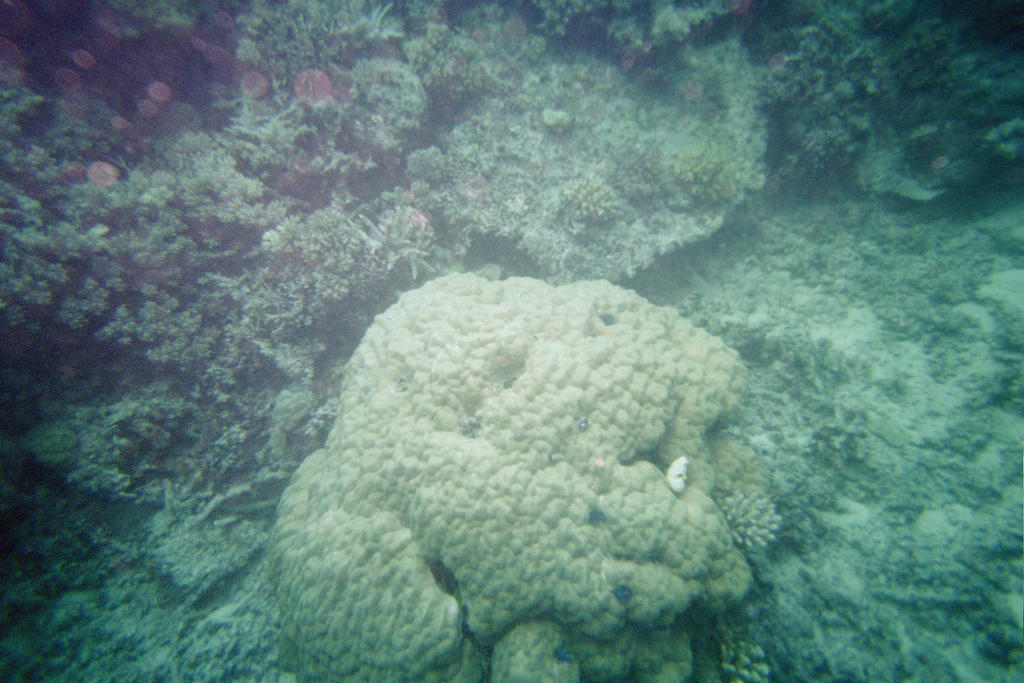
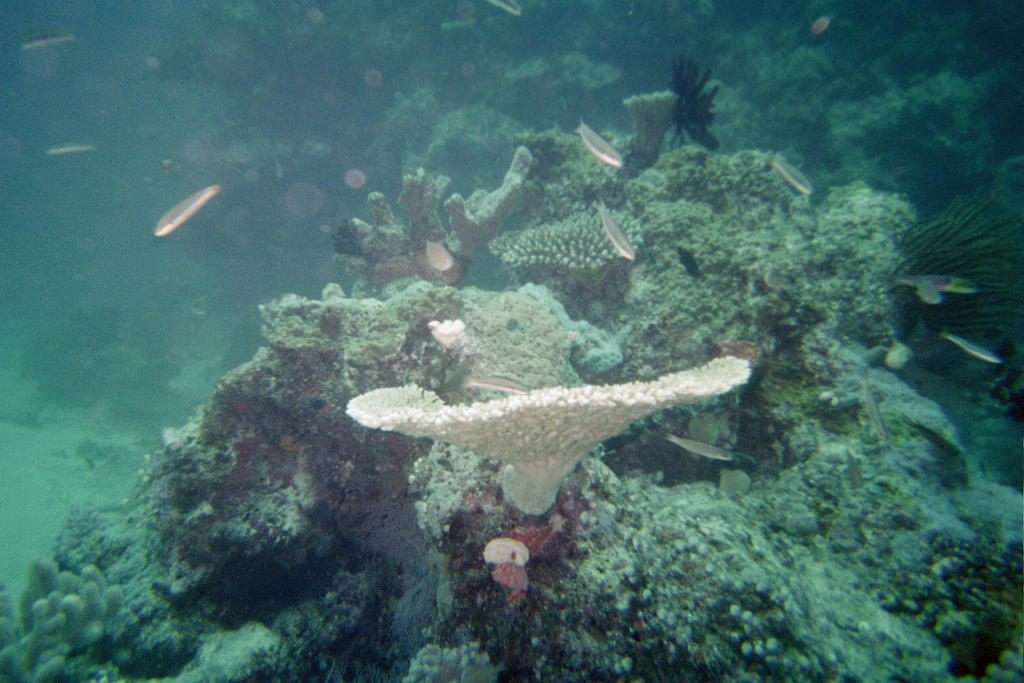
We finished the first dive without incident, did our safety stop, and then changed our tanks out. I signed up to do a second dive and got paired up with a guy that had only dived 9 times. I wasn't thrilled with that. I prefer to dive with experienced divers since they know what they're doing. I have over 80 dives to my credit but before the reef dives, I hadn't dived in over 2 years. I still knew what I was doing but, I wasn't super confident. I'd never dived the Great Barrier Reef before and it is a good thing to dive a new area with someone who is experienced in that area for at least a couple times. I wouldn't have that luxury here. Fortunately, the second dive was equally uneventful as far as diving problems go. I did get to take my first underwater photos which are what you are looking at on this post. The company sold cheap underwater cameras and I decided to try it out. To my delight, the photos came out reasonably well.

Overall, I ended up having an absolutely awesome time. It made me wish to do more diving when I got back to Maryland. Unfortunately, where I live is at least 3 hours driving from the coast and the water is very cold here. The only time you can dive with a wet suit is during the summer months. I did get my dry suit qualification but, I haven't cared to spend the money on one yet. I don't know how much I would use it. Hopefully, I'll get to do more diving in the future.

Those who do two dives out on the reef never get a chance to try the excellent buffet lunch the Quicksilver company provides. Fortunately, the company takes this into account and the diver can arrange for them to put aside 3 plates! of food for them when the reboard the boat. I got to eat the food on the way back to port and it was delicious. The drive back to Cairns was also very pleasant. We drove along the coast and got to see lots of seashore and water. When I arrived at the hotel, to my delight, our tour guide Jann Elphinstone invited me to join her for dinner in Cairns. She also invited Harvey and that is when I got to know him somewhat better. The three of us had a dinner at a food court in town and had a nice chat. I ended up having some lacklustre Thai food and a rather poor smoothie. Jann also recommended I try Bundaberg Rum (the local rum which was supposed to be very good) and XXXX beer. I found the rum was all right though I confess, I'm not real keen on hard liquor. The beer was also good. The one nice thing about trying the two was I slept like a rock that night though I might've been a little worn out from the diving too.

The next day would be our last day in Cairns. We would get to ride the Kuranda train, see the town of Kuranda, ride the Skyrail back to Cairns, and visit an aborigine cultural center. It would be another very full day. Stay tuned for Cairns - Part III.